Review & Giveaway: JEM Raw Organic Nut Butter

June 12th, 2013 by Roxanne | 29 Comments | Filed in Giveaways Email to a friend

Today we have a great giveaway to announce. Three lucky readers will receive a jar of JEM Raw Organic Nut Butter!

JEM Raw Organics is originally a chocolate company. Their chocolates are made with simple, pure ingredients, blending superior raw, organic ingredients and never contain gluten, dairy, soy or processed sugar. They have just recently starting making their own specialty nut butters in some very unique flavors. One of the most popular flavors is the Cinnamon Red Maca Almond Butter - which is the flavor that the winners will get to try.

In addition to the unique flavors JEM Raw Organic Nut Butters are made with optimal digestion in mind. They are sprouted, dehydrated, and slow ground. Other nut butters you will find in stores are not treated with this type of care. Usually to get such a high quality nut butter you would have to make it yourself – that is a huge benefit of these nut butter products.

I was very excited to receive my sample of this product. We love nut butters and the unique blended flavors that JEM offers sounded delicious.  The Cinnamon Red Maca Almond Butter is really delicious, it has a warm cinnamon flavor and a sweeter taste then the usual almond butter. I enjoyed eating it on apple slices as a healthy dessert or snack. The great thing is that it is sweet enough to satisfy a sweet tooth without anything unhealthy. We also enjoyed this nut butter on top of my Almond Flour Brownies – that was really amazing. I always say, eating healthy doesn’t have to be boring – and in this case it’s anything but boring!

Today I am planning on making gluten-free banana bread and was thinking how great it would be with some of this almond butter on top of it – kind of a healthy spin on a peanut butter and banana sandwich.

If you want to try JEM Raw Organic Nut Butters right away, they are offering 15% off web orders! Visit this link on Facebook to get the coupon code: 15% off JEM Raw Organic (Please note this link will not work on mobile devices).

What would you like to try with this almond butter?

Enter this giveaway below…


a Rafflecopter giveaway

Flowers for Skin Care (& 25% off My Serum)

June 11th, 2013 by Roxanne | No Comments | Filed in Natural Beauty & Personal Care Email to a friend

There are so many amazing things we can do with plants. Herbs have widely known medicinal properties and certain parts of each plants have different uses. The roots and leaves of plants are used for many different purposes and some plants even have powerful flowers. Flowers are not only just beautiful to look at and smell but they have some amazing medicinal properties. Some common flowers that may already be in your garden can be used for their natural powers. There are a number of flowers that are amazing for skin care because of their healing and renewing properties. Here are a few of my favorites.

Rose Hips

Rose Hips are the fruity pod left on a the flowers of a wild rose bush once the petals have fallen. The oil extracted from rose hips contains high levels of Vitamin A, Vitamin C, Iron and Fatty Acids which are all beneficial to the skin. Rose hip seed oil is a “dry” oil that absorbs into the skin very easily so there is no greasy feeling when applying it. Rose hip seed oil promotes skin regeneration and has provided wonderful results in soothing and healing sun burns and skin burns. It also lightens dark spots, acne scars, sun spots, stretch marks, and imperfections in the skin. It promotes the skin’s natural regeneration cycle helping it produce more collagen and elastin. The Fatty Acids in the oil rejuvenate and bring a smooth, youthful appearance to the skin. As a skin care product junky I replaced my old nasty anti-aging products with rose hip seed oil (read more about that in this post: Natural Alternative to Retinol). I purchase my rose hip seed oil from Mountain Rose Herbs.

Rose hips are not only useful just for the oil but they can be used in teas, infusions, tinctures, and syrups. I often add rose hips to my Elderberry Syrup recipe because they are so high in vitamin C. Used in a water infusion, it makes a great addition to a homemade facial wash or toner. Rose petals are also often used in skin care. Rosewater which is made from rose petals is very soothing to the skin and is used in many natural skin care lotions.

Lavender

Lavender is another one of my favorites. Lavender is one of the most gentle essential oils and has a variety of uses.  In addition to helping skin problems, this oil has been used since biblical times for headaches, stress, disinfecting, burns, depression, and insomnia. It’s gentle nature allows lavender essential oil to be applied directly to the skin with out dilution. Lavender is an effective treatment for acne, eczema, dermatitis, and insect bites, and other skin irritations. Since lavender is both antiseptic and anti-inflammatory it is also a great remedy for burns. On top of all it’s healing properties, lavender smells amazing and is a great scent for any skin care product.

Calendula

Calendula flowers are used for many things from first aid to beauty. It is a great flower to use in salves because of it’s antiseptic, antibacterial and antiviral properties. This makes it useful for healing cuts, wounds, and rashes. In addition to it’s healing properties it is also used in beauty products because it is moisturizing to the skin and helps to heal scars and thread veins on the face. Calendula helps to reduce scars formed on any new wounds but also works to improve the appearance of existing scars. It is also soothing to vericose veins.

Renewing Facial Serum Discount

These are three flowers I use regularly in my skin care routine. They can be used in the form of essential oils and infusions pretty easily. All three of these herbal flowers are used in my Renewing Facial Serum – which is my absolute favorite skin care product. This is the one thing I use every single day because it’s so effective and requires little effort to use. Yes, my opinion is a bit biased since it’s my own product, but there are a few awesome ladies who agree with me. Britni Ross from Our Eventual Homestead just wrote about her experience with this product and one of my other recipes from The Holistic Mama’s Guide to Homemade Skin Care, read what she has to say here. Also, read reviews from these bloggers as well…

Try my Renewing Facial Serum for 25% off between now and June 21st. Use coupon code “25off” at checkout.

Do you use these flowers in your skin care routine?

Grow Veggies from Kitchen Scraps

June 10th, 2013 by Roxanne | 2 Comments | Filed in Organic Gardening Email to a friend

A few months ago, I came across some pins on pinterest about re-growing food from kitchen scraps and I was intrigued so I decided to try it myself. Surprisingly, there are a number of veggies that will re-grow from scraps. I love this idea because it reduces waste, creates more food for no extra money, and it even works in container gardens. These vegetables can be propogated as many times as you want. It is best to use scraps from organic vegetables to make sure there are no pesticides or GMO’s. Here are some to try…

Leeks, Green Onion, and Fennel

After you remove the bottom root off of the leek, onion, or fennel, place it in a small amount of water (as pictured) and you will see the center start to sprout up within a day or two. There are two things you can do with this sprouted kitchen scrap. It can be left in the glass of water indefinitely and as it grows snip off what you want to use and then let it keep growing. In this case, you would change the water once a week. The second option is to remove it from the water once it has sprouted and plant it in the ground or in a pot of soil until it grows back to full size and you can harvest and repeat the process.

Here is my leek after it was in a pot for about 3 weeks…

Celery, Bok Choy, and Lettuce

The method for re-growing these veggies is pretty much the same as the above category. Place the bottom from your celery, bok choy, or lettuce in a small amount of water. You will see it sprouting up after a few days. At this point transfer the root into the ground or into a pot to grow. Once it is full grown, harvest and re-grow.

There are also some vegetables that can be grown from the actual vegetable itself. There is no need to buy seeds or plants, all you need is some vegetables from the farmers market or supermarket.

Garlic

A head of garlic is grown from one individual clove. Buy a few heads of garlic from your farmers market and separate the bulb into cloves. Plant each individual cloves in the ground as if you would a seed. Once the garlic has established itself again it will start to produce scapes (the green stalk). Cut off the scape at the first leaf joint after it’s made a few loops. The idea being that the garlic, having no flower to divert resources, will then focus its energy on becoming a full bulb. Once you harvest the garlic, remove a few cloves and repeat this process to grow more garlic.

Ginger

Growing ginger is very simple. Purchase a piece of ginger root and cut into small chunks. Simply place a chunk of ginger root in soil with the newest buds facing up and it will start to grow. When you harvest, pull up the whole root, remove a piece of it (or a few pieces), and plant it again to keep the cycle alive.

Have you ever tried doing this? What vegetables work best?

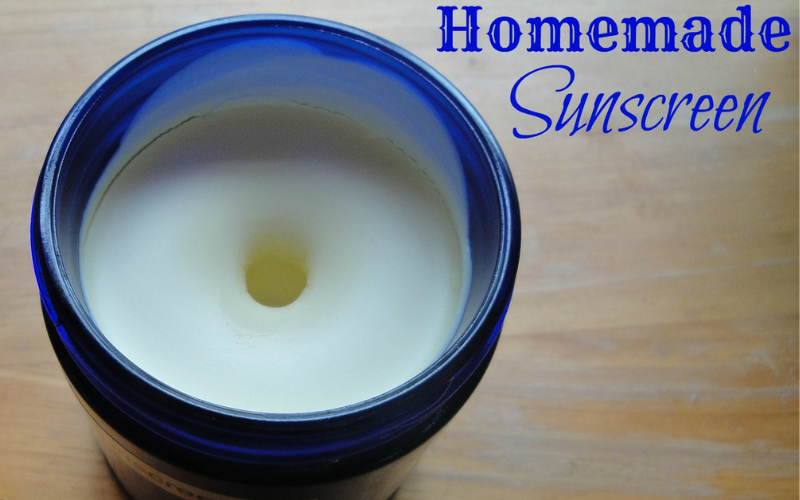
Homemade Sunscreen Recipe

June 3rd, 2013 by Roxanne | 9 Comments | Filed in Eco & Toxin-Free Living, Natural Beauty & Personal Care Email to a friend

There are many reasons to be concerned with commercial sunscreens (read this post: Is Sunscreen Healthy?). Some chose not to use it at all because of these concerns. Most of the time it is possible to get away without it but I find I still need some protection when we are out in the sun for long periods of time or in places where there is little or no shade.

There are very few sunscreens that I trust and some of them are hard to find or very expensive so making my own is a great alternative. We used this sunscreen last week when we were outside gardening all day and it worked great. If you are looking for an alternative to commercial sunscreens this is a great way to go.

Sunscreen Recipe

In a double boiler, warm the olive oil, almond oil, and beeswax on low heat until the bees wax is melted.

Once all of the bees wax pastilles are melted, remove the oils from the heat. Add in the zinc oxide powder, and whisk until combined. Once it is incorporated into the oils, add the vitamin e oil, rose hip seed oil, and essential oils and whisk again. Pour the mixture into a jar to store. Any small glass jar will do – even an empty jar from jam, baby food, yeast, etc. works great. Put in the refrigerator to cool for 20 minutes.

Looking for more personal care recipes like shampoo, body lotion, hand sanitizer, and insect repellent? Check out my eBook, The Holistic Mama’s Guide to Homemade Skin Care.

Do you make homemade sunscreen? What is your favorite recipe?


Is Sunscreen Healthy?

May 31st, 2013 by Roxanne | 1 Comment | Filed in Eco & Toxin-Free Living, Natural Beauty & Personal Care Email to a friend

Since Memorial Day is the unofficial start of Summer, I thought it would be a great time to talk about sunscreen. Until recent years not many people questioned the safety of sunscreen. It was assumed that sunscreen was healthy and helped protect us from dangerous UV rays. More recently sunscreens have been scrutinized for their questionable ingredients and effectiveness.

What’s wrong with sunscreen?

There are a few points to be made in the case against sunscreen. First, there are a number of chemicals used in sunscreens that can be damaging to our health. The chemical oxybenzone, for example, is one of the most commonly used ingredients and has cause for concern. Oxybenzone penetrates the skin, gets into the bloodstream and acts like estrogen in the body. It can also trigger allergic reactions. According to the Enviornmental Working Group (EWG), this chemical has been shown to be a cause of endometriosis and low birth weights in daughters of pregnant women who had higher levels of oxybenzone during pregnancy.

Nano particles are also a concern. In an effort to make suncreen lotions less chalky, manufacturers started using ingredients with smaller particles. In sunscreen lotions it has been found that it is unlikely that the nano particles will penetrate the skin, the bigger concern is with inhalation or ingestion of the particles. Inhalation can occur in use of spray sunscreens which are not recommened by EWG because of this safety concern. The International Agency for Research on Carcinogens has classified titanium dioxide as a “possible carcinogen” when inhaled in high doses.  The lungs have difficulty clearing small particles, and the particles may pass from the lungs into the bloodstream. In addition, nanoparticles in lip sunscreens can be swallowed and might damage the gastrointestinal tract.

In addition to safety concerns about the ingredients, wearing sunscreen effectively blocks your body’s production of vitamin D, which happens naturally when your skin is exposed to sunlight. In fact, sunscreens reduce vitamin D production by as much as 97.5 to 99.9 percent. Wearing sunscreen daily certainly reduces your vitamin D production and causes a Vitamin D deficiency. Vitamin D deficiency has been linked to a long list of diseases including heart disease, diabetes, osteoporosis, and rheumatoid arthritis.

There are two types of UV wavelengths – UVA and UVB. The UVA rays are what we want to avoid because it penetrates your skin more deeply and causes more free radical damage. The UVB rays are what helps us produce Vitamin D. The only way for a sunscreen to be effective in protecting your skin from melonoma and sunburn is if it can block UVA rays. There are two non-toxic ingredients that scatter both UVB and the more damaging UVA rays are titanium dioxide and zinc oxide.

Diet for Sun Protection

A diet full of vegetables and fruits may help protect your skin from the sun. Plants produce antioxidants to help protect their own tissue from the sun and when we consume these antioxitants it helps to protect our cells from the sun. The carotenoids in brightly colored fruits and vegetables are very beneficial to our health and may help protect skin cells. A specific carotenoid called astaxanthin, which is now believed to be the most potent antioxidant nature has to offer. Astaxanthin can be found in salmon, shellfish, and krill but it can also be taken in supplement form.  It is also a  potent UVB absorber and reduces DNA damage. This along with the omega-3 content of these fish make them an ideal food to include in your diet for sun protection. Chlorella and spirulina also contain astaxanthin which is the food source in which these fish obtain their high levels of this carotenoid.

Sticking to a real food diet full of whole foods (especially vegetables and fruit), low in sugar and processed foods is beneficial for sun protection – as well as overall health.

Natural Alternatives to Toxic Sunscreen

The EWG’s Skin Deep Database is an excellent resource to use to check the safety of the products you are using. It also helps to research  better alternatives to sunscreens you may have used in the past. There are natural sunscreens that are safe to use. Many people are choosing not to use suncreen at all because of the problems that may occur from Vitamin D deficiency and the lack of options available in local drugstores. If you chose not to use sunscreen it is best to take some of the following precautions:

  • Wear protective clothing – hats, sunglasses, swim shirts, long sleeves
  • Use an umbrella at the beach to provide shade from the sun
  • Don’t stay out in the sun during peak hours of the day
There are a number of natural ingredients that help with sun protection. They can be used in combinations or alone for natural protection. The best way to get adequate protection is to mix these oils with Zinc Oxide powder.
  • Carrot Seed Oil
  • Raspberry Seed Oil
  • Coconut Oil
  • Olive Oil
  • Shea Butter
  • Macadamia Nut Oil
  • Almond Oil
  • Jojoba Oil
Most of the above listed oils can be purchased from Mountain Rose Herbs, they are one of the sources for ingredients that I trust. I just recently started making my own sunscreen lotion, here is my recipe: Homemade Sunscreen Recipe.

My Thoughts on Sunscreen

In order to get adequate sun exposure for Vitamin D production, I only use sunscreen when we plan to be out in the sun for longer periods of time or when there is little or no shade. I feel its important to first protect yourself with clothing, and other protective gear then to always slather on the sunscreen. I also chose my sunscreens very carefully. Only using natural sunscreens approved on EWG Skin Deep Data base or my own homemade version. While Vitamin D is very important I do think we should be cautious in the sun and should think about protection from UVA rays.

This post was shared on Food Renegade and Simply Sweet Home

What are your thoughts on Sunscreen Use?

Safe Outdoor Play

May 29th, 2013 by Roxanne | No Comments | Filed in Parenting & Children Email to a friend

Outdoor play is so important for children. It’s a great way for children to connect with nature, explore, and develop motor skills by running, climbing, and other things they cannot do inside.  It is also a great way to entertain children instead of using electronics like television. Playing outdoors often keeps children entertained much longer then inside play. After spending a lot of the Winter indoors, their inside toys don’t seem to be as exciting. Getting outside to play provides a lot of new things to play with and explore.

Most Moms worry at least a little bit about safety. No one likes to see their children get hurt. Playing outside brings up a few issues about safety and security – falling down, wandering out of the yard, or getting into things they shouldn’t. These things are some concerns of mine so I have tried to come up with ideas to minimize the risk. There are so many developmental benefits to letting kids play outside that it’s best to not let these worries get in the way of allowing them to play outside. Of course there is no way to make sure kids never fall or get hurt but at least we can do some things to make their play space a little safer.

Swing Sets

We recently put a swing set in our yard and safety was definitely a concern. In the directions for set up they are very serious about calling your attention to the safety issues there are with swing sets (probably a legal thing) which made me think. Some points on the apparatus are pretty high up so a fall from one of those higher levels could potentially end up with an injury or even a broken bone. Aside from teaching the children to be careful, an easy way to minimize this risk is to create a softer surface under the swing set with mulch, wood chips, rubber mulch, or rubber mats.

Something else to think about when setting up a swing set is to put it in an area of the yard that is easy to see so that children can be watched and supervised. It’s harder to keep an eye on them and monitor what they are doing if the swing set is set up in a corner or an area that is hard to see.

Create Space that Belongs to Them

A great way to keep children entertained with things that are safe is to create spaces that are just for them. If your children are interested in gardening, let them create their own kids garden space where they can plant things that they want. Provide safe kid-friendly garden tools for them to use to dig and rake. This will minimize the risk of them wandering into the shed and getting into the dangerous garden tools we don’t want them to play with. Another idea is to make a Fairy garden or a Gnome house for imaginative play. We had an old bird bath that wouldn’t hold water anymore so we filled it with dirt and moss and created a fairy garden. My daughter will go and play there to check if any fairy’s moved into the house. There are a lot of great ideas like these on Pinterest.

Creating these types of outdoor play spaces helps to keep them interested in staying in the yard instead of wandering off outside the yard with the potential of getting to close to street traffic or other dangerous areas. If you live near or on a busy street with a lot of traffic, you might even want to try something like a gate alarm that lets you know if they gate has been opened.

Edible Plants and Non-edible Plants

Our house has a lot of interesting plants, flowers, and shrubs and my husband and I both love gardening. I especially love vegetable gardening and my daughter often helps with planting, watering and of course picking. She will pick the cherry tomatoes and berries right off the plant and eat them. I love that she does that because I think it’s a great way to connect her to where food comes from. As she gets older and more comfortable with plants and eating them I worry that she might eat something off a plant that is dangerous. Of course, teaching our kids what plants are okay to eat and what are not is very important but kids are kids and they may not remember. It is almost impossible to remove all plants that might be of concern – also because a lot of them are common things in a garden such as wisteria or foxgloves. A good solution might be to keep the non-edible plants in the front yard of your house or areas where the children don’t often play. My solution is to create a section of the yard that is edible and explain to the children that they can only eat things from this one area.

There are always things that we can worry about as Moms. As I get more experienced as a Mom I find the best thing to do is to be creative about ways to minimize risks. I hate to think that my worries inhibit my children from playing freely. We want kids to be kids but we also want them to be safe.

What are your outdoor safety concerns? And how do you minimize the risks?

Mini Quiche Recipe

May 27th, 2013 by Roxanne | No Comments | Filed in Healthy Recipes Email to a friend

Quiche is a great way to hide veggies. If your children turn their nose up at kale, this might be a way to sneak it in their diet. Most kids love scrambled eggs so this is usually not a hard sell. Handheld food or “mini” versions of things are also a great way to get kids interested. My daughter loves anything “mini” she called these “baby quiches.” These are great because they work for a quick breakfast on a busy morning, a side for lunch or dinner, or even a protein packed snack.

I have seen a lot of recipes around for mini quiche or “egg muffins” but most of them required substitutions to make them work for us so I created this dairy-free and wheat-free recipe. The coconut milk makes them nice and fluffy and satisfying. Use up any extra cooked vegetables you have laying around in this recipe.

Mini Quiche

  • 4 organic pastured eggs
  • 1 can of coconut milk (13 oz.) – I like Native Forest becuase their cans are BPA free
  • ½ tsp. sea salt
  • Your choice of 2-4 add ins:
    • Steamed broccoli
    • Cooked brown rice
    • Diced ham
    • Diced cooked potatoes
    • Peas
    • Crumbled bacon
    • Corn kernels
    • Sautéed kale, spinach, collard greens
    • Sautéed onions
    • Sautéed zucchini
    • Steamed carrots
    • Or anything else you have that needs to be eaten!

Prepare a muffin tin, lined with baking cups (use an unbleached version like If You Care). In a medium mixing bowl, whisk together the eggs, coconut milk, and sea salt. Cook add-ins if needed. Add to the bowl and mix together. Use a ladle to spoon the egg mixture into the baking cups. Bake at 375 for 20-25 minutes until a toothpick comes out clean.

Need more easy real food recipes? Join our real food community and get an eBook of recipes and a meal plan!

 Do your kids eat quiche? Give these a try!

Hidden Toxins in Our Food

May 22nd, 2013 by Roxanne | No Comments | Filed in Eco & Toxin-Free Living, Nutrition Email to a friend

Good ol processed lunch meat

Photo by American Eater

Toxins in cleaning products seem a little more obvious then toxins in our food but unfortunately there are many in both.  Food additives and man made chemicals are found in countless “food” products. The majority of them cause some kind of negative health effect so in my opinion they have no place in our food. Usually they are used to prolong shelf life of products or make them look more visually appealing to increase profits for food giants like Monsanto. Health effects were not a concern when these things were first introduced to the public but as years go on it is obvious that they are not safe for consumption.

There are many additives and chemicals to watch out for in our food. Below you will see a list of four important things to avoid that you may not be thinking about.

Processed Meat

Processed meats include bacon, hot dogs, sausage, and deli lunch meats. The conventional versions of these foods contain Sodium Nitrate which has been linked to cancer and could be a cause of heart disease. It is added to these products as a preservative and coloring to make it look more appealing. According to Natural News, The USDA actually tried to ban sodium nitrite from the food supply back in the 1970′s, but it was overruled by the meat industry which knew that the chemical made meat look visually more appealing. It’s best to avoid all products containing sodium nitrate which means eliminating processed meats from your diet or finding products that do not contain this toxin. There are organic versions of these products such as Applegate Farms or a local farm resource.

Fish

Although fish is a healthy food, so much of the fish we eat is contaminated with mercury. Overexposure to mercury can cause memory problems, fatigue, and other health issues. The best way to avoid mercury is to choose low-mercury fish like flounder, salmon, and shrimp. For a detailed list of all low, medium, and high mercury fish visit www.nrdc.org

Canned Food

Most cans are lined with bisphenol-A (BPA). BPA is an endocrine disruptor which can mimic estrogen and has been shown to cause negative health effects in animal studies. It is not always easy to tell if all canned products have BPA but it is safe to assume they do. Some companies such as Native Forest Organic Coconut Milk use cans that do not contain BPA. To avoid this toxin, only buy canned products from companies that you know do not use BPA.

Hydrogenated Oils

Hydrogenated oils are use in many processed food products. These oils are used becuase they prolong the shelf life of these “foods” and last longer then oils that have not gone through the processing that hydrogenated oils go through. The problem with these oils is that they are very detrimental to our health. Trans fats, or partially hydrogenated oils, have been banned from use in some cities like New York City. Hydrogenated oils especially cause problems in the heart and blood vessels due to a thickening of the blood.  A 1993 Harvard study strongly supported the hypothesis that intake of partially hydrogenated vegetable oils contributed to the risk of having a heart attack. It’s best to avoid all foods that have hydrogenated or partially hydrogenated oils in the ingredient list. This can be tricky with foods that do not have labels such as bakery goods, so it’s best to avoid them unless you know what is in them.

Are you concerned about these hidden toxins? Share with us how your avoid them.


The Key to Making Real Food a Reality

May 20th, 2013 by Roxanne | No Comments | Filed in Planning and Organizing Email to a friend

Have you made changes towards eating a healthy real food diet but have trouble making it work all the time? As a busy mom, you are probably overwhelmed trying to figure it out on your own. We all want to get through the week without being forced to grab the processed convenience foods.

Well, I can relate to what it’s like to feel overwhelmed and tired of trying to make it work. There were many years in my life that I often felt it was impossible to make a real food lifestyle work all the time. Today, however, my life is a lot different. I figured out what I needed to do to make lasting and positive changes in my life and my diet in a way that I enjoyed and didn’t feel overwhelmed….And that’s exactly what I am going to teach you in my Online Meal Planning Workshop so that you can have the same results.

The reason why meal planning is the key to making real food a reality is because when you have no plan it’s impossible to create healthy meals and snacks without making yourself crazy. Taking a short amount of time each week to pick out recipes, make a plan, and put together a shopping list is how it’s done. You won’t believe the amount of stress having a meal plan will relieve. When you have a meal plan to follow just as you would follow a calendar it makes meal times much less hectic and provides you with the foundation to be able to provide a healthy meal for your family without being stuck in overwhelm mode. The reason why we end up using convenience products or take out is only because there is no other option at that moment and everyone wants to eat right away. In those situations there is no time to go to the store and then cook so the unhealthy food becomes the only choice. When you put some time and energy into planning these situations won’t occur.

Are you ready to…

  • Feel like you have more control over the meals you and your family eat?
  • Understand a simple process to make the whole lifestyle work on a regular basis
  • Have more energy for things other then figuring out what’s for dinner?
This is your opportunity to finally get a handle on the real food lifestyle, let go of overwhelm  and have the confidence that you are feeding your family healthy food. This course with permanently change how you feel about meal planning. In this course you will learn a simple process that will take away all the stress around meal times.

When you join this program you will receive…

  • A online webinar presentation that you can watch on your time – as many times as you want! ($97 value)
  • A meal planning binder with dividers and folders for organization – sent to you in the mail ($29 value)
  • Printed meal planning worksheets
  • A weekly schedule planning worksheet
  • Two sample meal plans – a Winter menu and a Spring menu – from the Real Food Challenges I’ve hosted ($38 value)
  • Sample Recipes
  • Helpful tip sheets
  • Membership to our private Real Food Facebook group for help and support (Priceless!!)

Join me in this home study online workshop for only $89.

This includes all of the supplies that get sent to you in the mail

Only $89

Do you have questions about this workshop? Please feel free to reach out to me using my contact form here.


Ingredients to Avoid in Personal Care

May 17th, 2013 by Roxanne | No Comments | Filed in Eco & Toxin-Free Living, Natural Beauty & Personal Care, Pregnancy & Natural Child Birth Email to a friend

Personal care products are filled with unhealthy ingredients. Conventional products in a drug store almost never live up to my standards. Even most products in a health food store still have a lot of junk in them. That is the point that bothers me the most because people buy these items in a health food store thinking that they are free of possibly harmful ingredients when it’s not the case. I have become quite the label reader and it takes me a long time to pick out products in a store when I need to buy them – which is why I rarely buy them anymore (I make my own instead). It is important to learn how to read labels but sometimes it feels like you need to be a scientist to figure out what any of the words mean.

Here are some of the ingredients to avoid because of their possible health effects…

Parabens

Parabens (esters of p-hydroxybenzoic acid) are used in personal care products as antimicrobial agents to preserve the product and prevent spoilage. When reading labels the ingredient might say Methyl, Propyl, Isopropyl, Butyl, and Isobutylparabens. The major problem with parabens is that they are estrogen mimicking substances that disrupt hormones. In a study published in the Journal of Applied Toxicology in 2004, called Concentrations of Parabens in Human Breast Tumours, reported that parabens were found in samples of tissue from human breast tumors in 19 out of 20 studied. Although the FDA acknowledges the hormone like qualities of parabens they still state the following (updated in 2007), “FDA believes that at the present time there is no reason for consumers to be concerned about the use of cosmetics containing parabens. However, the agency will continue to evaluate new data in this area.” I don’t know about you but I’m not willing to take their word for it.

Retinol

Retinol is a common ingredient in facial products like moisturizers, anti-aging products, and acne products. Words to look out for on lables might be Differin (adapelene), retin-A, renova, tretinoin, retinoic acid, retinol, retinyl linoleate, retinyl palmitate, tazorac and avage, and tazarotene. Retinol is a derivative of Vitamin A which encourages skin to regenerate which makes skin appear younger. The problem is that that new skin is more sensitive to sun damage, and can actually increase risk of sun damage and skin cancer when used in daytime products. The skin is not only sensitive to the sun but also to anything else you may use on it. It is even more important to be cautious about Retinol during pregnancy or breast feeding because of the high levels of vitamin A. If you are pregnant and you have been using skin-care products with retinol, don’t panic. No studies have definitively linked topical use of retinol to birth defects or harm to unborn infants. To be on the safe side, though, avoid skin-care products with this ingredient. Read more about this on BabyCenter. If you like the effects of products with Retinol in them and how it makes your skin look read my post on this effective natural alternative, Effective Natural Alternative to Retinol.

Fragrance

Fragrance is a term you see on most products. In the ingredient list it will simply say the word fragrance which seems harmless – especially next to all those chemical looking words that we don’t recognize. The problem with fragrance is that Federal law doesn’t require companies to list on product labels any of the chemicals in their fragrance mixture. This means we have no idea what is in it and if there are any health concerns. Recent research from EWG and the Campaign for Safe Cosmetics found an average of 14 chemicals in 17 name brand fragrance products, none of them listed on the label. Fragrances can contain hormone disruptors and are among the top 5 allergens in the world. Fragrance can also be an issue if you have food allergies – you don’t know if there are hidden things like gluten in there as well. To be safe, by fragrance-free products or make your own with essential oils instead.

If you are interested in learning more about making your own personal care products, my eBook, The Holistic Mama’s Guide to Homemade Skin Care is a great resource.

Were you aware of these potentially harmful ingredients in your products?


Related Posts Plugin for WordPress, Blogger...